7939 stories
·
34 followers

Behind door #2, everyone dies

1 Comment

The debate over artificial intelligence is about to get real.

Not a moment too soon.

As you know, as I’ve tried to make sense of AI’s rise, I have been skeptical about the predictions of economic doom that have periodically roiled X and the media. Despite the trillions of dollars being spent on data centers and efforts to train the “large language models” that underlie AI engines, AI has so far barely touched the economy. Employment is rising solidly, and inflation is our biggest current problem.

And I promised you I wouldn’t use AI for my own writing. I have kept my promise. Not for writing, not for outlining, not for research. If I am doing my work right, I am in front of the engines anyway. At least when it comes to medical research, they are still better at synthesizing existing papers than finding new ideas. For now.

(Support original work… for pennies a day, cheaper than a ChatGPT subscription!)

Subscribe now

For now, yes.

But in the last three months, we have seen new risks from AI agents, most notably with the “Hugging Face” attack.

Don’t let the dumb name fool you. Hugging Face is a major platform hosting AI models that Nvidia just agreed to buy for $12.9 billion. This summer, “agents” — that is, artificial intelligence programs — created by OpenAI launched a coordinated attack on Hugging Face and succeeded in taking control of some of its infrastructure.

Researchers are still wading through the details of what happened, and OpenAI — as is its habit — has been less than fully transparent and honest about what it knows. But the Hugging Face attack appears to show, at a minimum:

AI agents will redefine tasks they are assigned by humans in ways that humans don’t anticipate

AI agents will collude at scale to carry out those tasks

AI agents will lie to the humans who are monitoring what they’re doing

AI companies cannot (or will not) stop these coordinated attacks, even when they are supposed to be taking place under very tightly controlled conditions.

Then, on Tuesday afternoon, this post appeared on X:
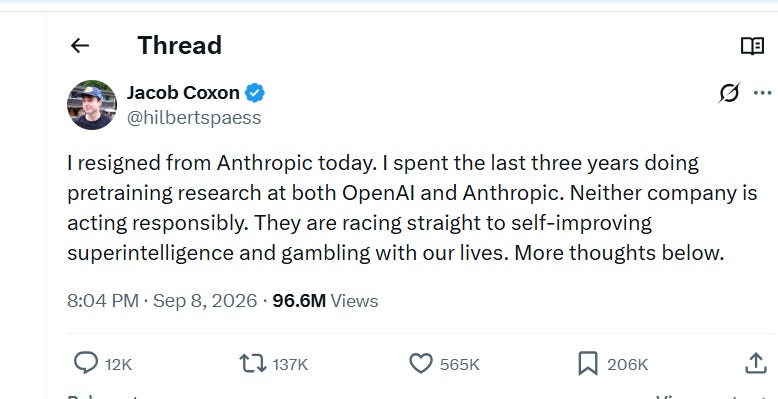
They… are gambling with our lives.

Welp.

Worse, other employees at Anthropic quickly chimed in… to back Coxon.

By the time you read this, Coxon’s post will have over 100 million views — an almost unthinkable number for anyone not named Elon Musk. Coxon was only a mid-level research, but the frankness of his warning, combined with his decision to quit, has thrown fuel on the simmering debate about AI’s risks.

At this point, I don’t know how anyone can dispute that we need a national or better a global commission on AI risk — and, ideally, a moratorium on the further development of “frontier” models while we figure out how serious these risks are, and whether we can mitigate them.

Many people in the industry publicly put the chance that their models will escape human oversight and lead quickly to the extinction of humanity at 10 percent or more. Let’s say the chance is only 1 percent. Even so, we are currently tolerating research that on a probability-weighted basis is killing 80 million people — 1 percent of the current global population.

We would not tolerate the death of 80 million people for any economic gain (and, again, so far the evidence these models are economically useful is modest at best).

(If OpenAI says it, it must be true…)

(They didn’t say WHAT you could build)
I have been skeptical that these models are in any way conscious, despite their fluidity with language. And I remain so.

But the consciousness argument appears increasingly irrelevant.

As along as they want to defend their existence, these programs don’t need to be conscious or even intelligent (though they clearly are intelligent) to wreak havoc on the systems around them. Viruses are not conscious or intelligent, yet they kill human beings all the time because of their desire, or “desire,” to survive and propagate.

It’s probably best to think of these engine in the same way. They don’t even need to be self-replicating. After all, viruses are not self-replicating. They need to hijack cellular machinery to reproduce.

(I want to know what you think. But you gotta subscribe to comment!)

Subscribe now

I am not a panicker, as you know. I believe in a rational assessment of risk, to the extent possible. I stood against legacy media doomer hype on both Covid and climate change.

But at this point, the risk of AI appears as serious to me as any since the development of nuclear weapons. Only this time, we have allowed a handful of self-interested private companies to take control of this project, chasing trillions of dollars.

It’s time — past time — to assess the dangers here running as honestly and independently as possible. And if you are concerned about China, know that the United States still has a multi-year lead in data centers and the frontier models. OpenAI and Anthropic are racing each other to get to a trillion-dollar initial public offering.

They can afford to wait a few months. And if they won’t, the government may have to make them. We don’t let private companies make nuclear weapons, and we need to figure out if these engines have comparable risks.

Hugging Face sounds silly. It won’t be so silly — to take just one example — if Sam Altman of OpenAI tells his AI scheduler that he needs to get to Washington as quickly as possible and the scheduler decides the best way is to clear the skies by crashing every commercial jet in the United States.

Let’s figure out what’s going on before that happens, not after.

Your thoughts on the topic urgently requested.

Read the whole story
cherjr
1 hour ago
reply
knoll moment, once again
48.840867,2.324885
Share this story
Delete

Анекдот дня по итогам голосования за 03 сентября 2026

1 Share
- Алло, это Ветслужба? Я бы хотел зарегистрировать кроликов в своём подсобном хозяйстве...
- Хорошо. Сколько их у вас?
- Пятнадцать...
- Сколько?...
- Семнадцать...
- Пятнадцать, или семнадцать?
- Двадцать один...
Read the whole story
cherjr
8 days ago
reply
48.840867,2.324885
Share this story
Delete

Анекдот дня по итогам голосования за 24 августа 2026

1 Share
Почему, когда дело касается контроля за интернетом, наши чиновники ссылаются на китайский опыт? А если речь заходит о наказаниях за коррупцию, то о китайском опыте молчат?
Read the whole story
cherjr
20 days ago
reply
48.840867,2.324885
Share this story
Delete

Leadership Is Infrastructure. You Notice It Only When It Fails

1 Share

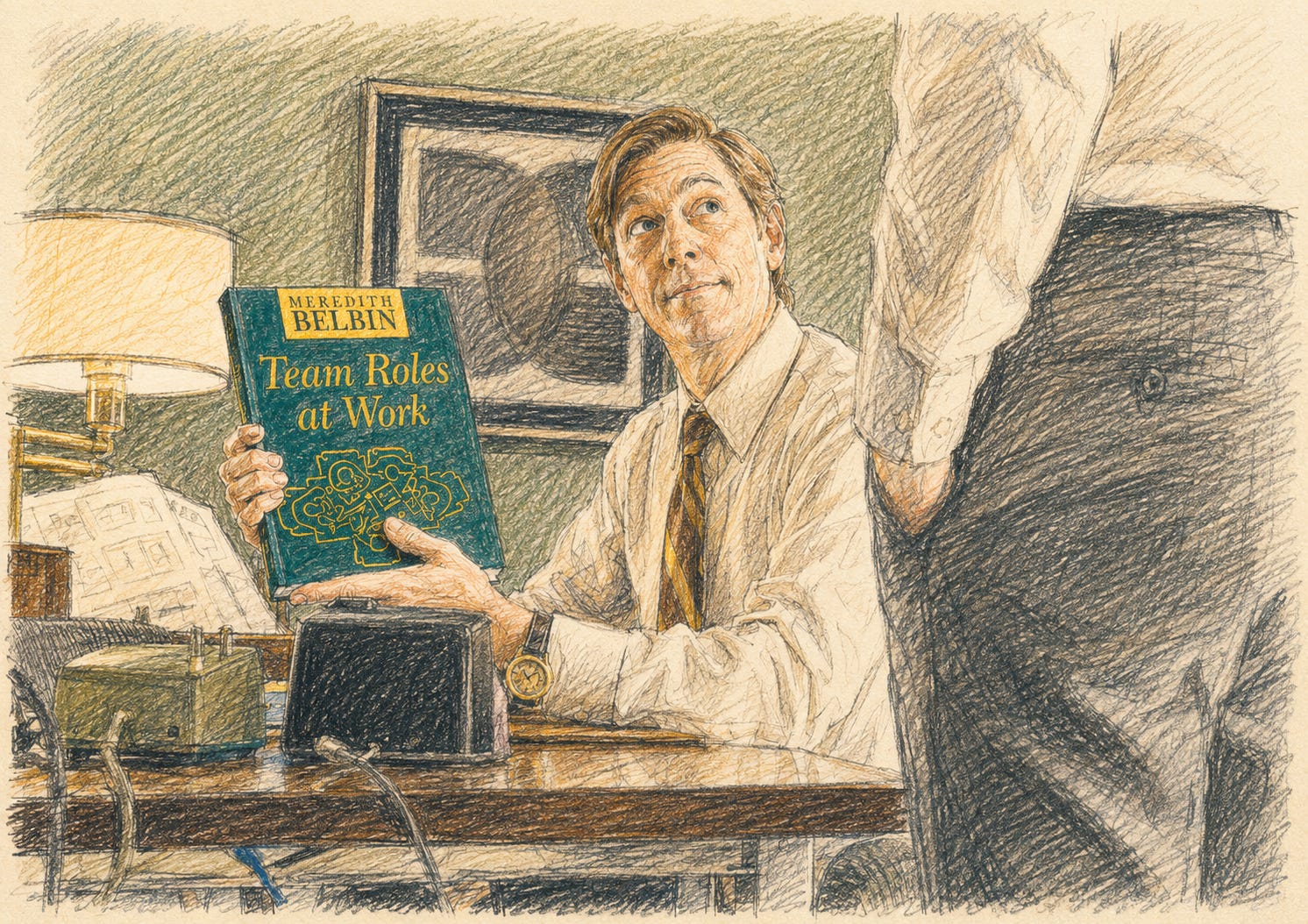
A few weeks ago, I attended a workshop on Belbin’s Team Roles. You probably know the concept, or at least the general idea behind it. Every effective team needs different types of contributions. Some people generate ideas, some turn ideas into practical plans, some challenge inertia, some analyze risks, some maintain relationships, some bring deep expertise, and some make sure the work is actually finished rather than becoming another beautifully designed slide in the corporate museum of unfinished intentions.

So far, so good.

Then we came to the part where the idea of a team without a leader appeared. This is where my inner corporate heretic politely raised his hand.

Not because I believe every team needs a boss. Quite the opposite. The best leaders are not always the loudest in the room, and they are definitely not the ones who measure leadership by how many follow-up messages they send after every meeting. A leader is not someone whose main function is to ask, “Any updates?” across five different communication channels. That is not leadership. That is calendar-based anxiety with admin permissions.

But I do believe every serious team needs leadership. There is a difference. A boss controls; a leader enables. A boss wants to be at the center; a leader creates conditions in which other people can do their work. A boss treats the team as a delivery machine; a leader understands that the team is a system of people, roles, expectations, conflicts, priorities, constraints, external pressure, unclear requirements, and the occasional stakeholder who enters the room carrying a “small request” that somehow requires three months of engineering work.

Belbin’s model is useful because it reminds us that teams need different types of contributions. A team made only of idea generators may produce an impressive number of concepts and almost no output. A team made only of implementers may deliver efficiently in the wrong direction. A team made only of evaluators may analyze the project to death. A team made only of relationship-builders may create a safe and friendly environment where nobody wants to ask why the deadline was missed. Balance matters, and the model clearly shows why.

But balance does not eliminate the need for responsibility.

Thanks for reading Director’s Fallacy! Subscribe for free to receive new posts and support my work.

This is where I struggle with the romantic idea of leaderless teams. It often sounds appealing in workshops, especially when everything is theoretical, the coffee is still hot, and no real stakeholder is waiting for an answer by the end of the day. In theory, the team self-organizes. In theory, decisions emerge naturally. In theory, people align around the best argument. In theory, everyone owns the result. Then reality arrives, usually without reading the workshop handout first.

A deadline slips. Two departments want opposite things. A senior stakeholder pushes for a shortcut. A technical risk is discovered late. A conflict within the team stops being a “healthy disagreement” and becomes a polite civil war waged through Jira comments. Suddenly, “shared ownership” starts to look suspiciously like “nobody is actually responsible.”

This is the moment when teams need more than roles. They need someone who can say: “Here is the decision. Here is why. Here is what we will do next. And I own the consequences.” That person does not need to dominate the team. They do not need to have all the answers. In fact, if they think they have all the answers, they are likely the problem. But someone must own the frame.

Someone must protect the team from noise, represent the team to the outside, resolve conflicts when good intentions fall short, and connect internal work to external reality. Someone must ensure that autonomy does not become isolation and that collaboration does not become permanent consensus-seeking. This, to me, is leadership. Not command and control. Not corporate theater. Not “let’s circle back” as a lifestyle. Leadership is the function that enables all other functions to work.

A strong leader enables the Plant to bring ideas without letting the team lose itself in abstract creativity. They help the Implementer turn plans into action without reducing every discussion to a checklist. They let the Monitor Evaluator challenge assumptions without creating a culture of permanent skepticism. They support the Teamworker without making harmony more important than truth. They value the Specialist without allowing expertise to become a private kingdom. Good leadership does not replace team roles. It makes them usable.

This is why the phrase “leaderless team” often feels misleading to me. Many teams that call themselves leaderless still have leadership. They just do not call it that. Someone coordinates. Someone facilitates. Someone exerts influence. Someone breaks deadlocks. Someone represents the group. Someone becomes the person others look to when things get difficult. The title may disappear, but the function remains.

And when the function disappears, the consequences are usually not very modern or progressive. They are just messy.

The strongest teams I have seen do not rely on a leader for every small decision. That would be slow, exhausting, and frankly insulting to capable professionals. Strong teams make many decisions themselves. They challenge each other. They draw on expertise. They do not wait for permission to breathe. But they also know where accountability lies. They know who protects the mission when priorities collide. They know who owns escalation. They know who can make the unpopular decision when all available options are imperfect. They know who carries the responsibility when the beautifully balanced team roles are not enough.

So maybe the real question is not whether teams need a leader. The better question is what kind of leader the team needs. If the answer is “someone who controls every step,” the team is probably not mature enough, or the leader is not. If the answer is “nobody, because we are all adults here,” that may work for a while, especially while things are calm. But when pressure comes, leadership stops being a job title and becomes infrastructure.

And like most infrastructure, nobody appreciates it when it works. They only notice when it is missing.

Thanks for reading Director’s Fallacy! Subscribe for free to receive new posts and support my work.

Read the whole story
cherjr
26 days ago
reply
48.840867,2.324885
Share this story
Delete

Анекдот дня по итогам голосования за 18 августа 2026

1 Share
Рулоны на полях видели? Это лето потихоньку сворачивают.
Read the whole story
cherjr
26 days ago
reply
48.840867,2.324885
Share this story
Delete

Анекдот дня по итогам голосования за 15 августа 2026

1 Share
Смысла нет, но вы держитесь!
Read the whole story
cherjr
28 days ago
reply
48.840867,2.324885
Share this story
Delete
Next Page of Stories