7958 stories
·
34 followers

On the painful prescience of Seinfeld

1 Share

It’s about nothing. A show about nothing.

Those words famously summed up Seinfeld, the NBC comedy that ran from 1989 to 1998, the last decade when network television dominated American culture. 76 million people watched its last episode on May 14, 1998, a 41 rating — meaning that 41 percent of all American households saw it live. That number is Super Bowl-sized, unthinkable for a scripted show now. Along the way Seinfeld spawned endless bits of the cultural shorthand we now call memes: Not that there’s anything wrong with that, master of my domain, the Soup Nazi, sponge-worthy, yada yada yada…

Yet Seinfeld is not as loved today as Friends or The Office. Not even close. Those shows, The Office in particular, remain cultural touchstones and over the last decade drew a new generation of viewers on streaming services. Seinfeld is barely a curiosity.

It’s easy to write that gap off as generational turnover. Who talks about MASH these days, after all? But after catching up on Seinfeld with my 11-year-old, I think the real reason the show has lost its purchase is not that it seems dated but the opposite. Despite its answering machines and references to MovieFone (look it up, kids!), the show feels modern in a way its writers could not have anticipated 30 years ago.

Among the many arguments swirling around AI: what happens if the engines lead to a big rise in white-collar unemployment? (To be clear, we have little evidence of AI-related job losses at the moment, but the left is pushing increasingly seriously for universal basic income either way.) What does a world of educated but unmotivated, childless adults look like?

We’ve seen it.

It’s called Seinfeld.

—

(The drug investigations you expect, the cultural criticism you don’t, all for pennies a day. Support UT. It’s NOT about nothing.)

Subscribe now

—

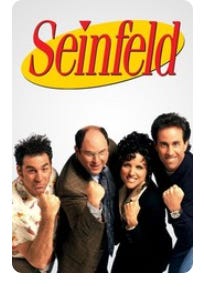
The ur-joke of Seinfeld, of course, is that it’s the story of four friends who are all absurdly self-centered. They like one other, and they’re loyal in a watery way. But they never seem willing to sacrifice anything important for each other, much less anyone else.

Jerry is ironic and detached, his comedy a run of clever but superficial observations; George is self-pitying, lazy, and weak; Kramer is a scammer and fool whose schemes don’t have a prayer of working; Elaine is sluttish and catty.

The show was made in an era before dating apps, of course. But it perfectly captures their looks-first, swipe and repeat ethos. The four friends are single when the show starts. They are single when it ends almost a decade later. Jerry tells Elaine only 5 percent of women are pretty enough to date. He meets an endless array of beautiful women, but nothing ever works out, and as soon as one leaves, he moves to the next.

George, short and bald, believes being with a beautiful woman is his birthright. After the show’s midway mark he decides he needs to get married so he won’t be alone. He proposes — and immediately regrets doing so. When his fiancee dies accidentally (poisoned by licking the cheap wedding envelopes he’s picked out), he can barely pretend to care. Elaine and Kramer are equally feckless.

—

(It’s the show that got small)
—

Nor do the fab four care about their jobs. Jerry is the only one who has anything resembling a career, and the show deemphasizes his work in its later years.

They watch a lot of television, but they have no real hobbies or interests except for Jerry’s love of the Mets and occasional shopping trips. They like the sort of pointless competitions that gambling apps foster now. Had Doordash and Amazon Prime existed at the time, they would never have left their apartments.

Of course they are not charitable or religious. A secular Jewish ethos (rootless cosmopolitans!) — undergirds the show, which may be another reason Generation Z doesn’t like it. In the real world, Jerry Seinfeld has come under fire recently for his vocally pro-Israel views.

As for families, children have essentially no role in Seinfeld. One episode hinges on a baby’s supreme ugliness. None of the four have kids or want them in any meaningful way. Why would they, given their own relationships with their parents? Jerry’s mother and father are old, dumb, and overbearing. George’s are worse, constantly screaming at each other and at him. Elaine and Kramer’s parents are barely mentioned. The four exist on their own, tied loosely together by a shared unwillingness to grow up.

This lack of forward progress cannot be blamed on the strictures of situation comedies; both Friends and The Office (among many others) are driven at their core by long-term romances. But Seinfeld truly is about nothing. The penultimate episode, a “clip show” of the most famous moments of the previous nine years, ends with the four stars stepping out of a subway car and walking in different directions.

A generation ago, before the opioid crisis killed over 1 million Americans, when the median age of marriage was under 27 for men and 25 for women, and the fertility rate roughly 20 percent higher than it is now, Seinfeld’s empty heart might have seemed funnier to the people watching it. Sure, they live in New York, they do what they like, but in the end, they’re really not very happy. Their lives are meaningless.

But to Gen Zers wondering if they will ever marry and have kids, own their homes, or have stable jobs, Seinfeld may look less like a window into a world of self-obsessed New Yorkers and more like a funhouse mirror.

When the joke is on you, laughing at it is much harder.


Read the whole story
cherjr
56 minutes ago
reply
48.840867,2.324885
Share this story
Delete

Американская KFC перейдет на напитки Coca-Cola после 40 лет партнерства с Pepsi

1 Share

Сеть ресторанов быстрого питания KFC перейдет на напитки Coca-Cola в США после 40 лет партнерства с Pepsi, пишет Reuters.

В KFC заявили, что переход на Coca-Cola произойдет в начале 2027 года. Финансовые условия сделки не разглашаются.

Как отмечает Reuters, потеря контракта с KFC, насчитывающей в США 3718 точек, «может стать ударом» для PepsiCo на фоне попыток нарастить продажи своих напитков в Соединенных Штатах, которые и без того затруднены трендом перехода потребителей на более полезные для здоровья продукты.

В PepsiCo отметили, что сотрудничество с ресторанами KFC за пределами США продолжится.

Напитки Pepsi появились в KFC в 1980-х годах, после того как компания PepsiCo приобрела эту сеть ресторанов. Позже PepsiCo выделила свой ресторанный бизнес (помимо KFC, компания также владела Taco Bell и Pizza Hut) в отдельную корпорацию Yum! Brands.

KFC — вторая в мире (после McDonaldʼs) сеть ресторанов по торговому обороту. Всего под этим брендом открыты около 32 тысяч точек.


Read the whole story
cherjr
1 hour ago
reply
48.840867,2.324885
Share this story
Delete

Explained: Where to get your clothes repaired or altered in France

1 Share
We all know that a stitch in time saves nine, but if you're not too handy with a needle France has plenty of options for getting clothes altered or repaired. Here is what to look for, prices and the government 'repair bonus'.

Read the whole story
cherjr
2 days ago
reply
48.840867,2.324885
Share this story
Delete

Анекдот дня по итогам голосования за 11 октября 2026

1 Share
У меня в жизни складывается только диван. И то не всегда.
Read the whole story
cherjr
3 days ago
reply
48.840867,2.324885
Share this story
Delete

Анекдот дня по итогам голосования за 10 октября 2026

1 Share
- Почему в двухместном Maserati помещаются пять девушек, а в пятиместных Жигулях - ни одной?
Read the whole story
cherjr
4 days ago
reply
48.840867,2.324885
Share this story
Delete

Would You Fly on a Minimum Viable Product?

1 Share

For years, the IT world had a simple mantra: Move fast and break things. Today, we’ve replaced it with another one that sounds much more responsible: Just build an MVP. Somewhere along the way, “start small” stopped being one useful tool among many and became almost a moral principle. Suggest spending six months building something before showing it to users, and someone will inevitably remind you that “this isn’t very Lean.” It’s an interesting shift. The same people who insist that every product should be an MVP would probably think twice before boarding an aircraft whose navigation system was developed the same way.

The problem is not the idea of an MVP itself. Quite the opposite. Some of the best products I’ve worked on started exactly that way. We had a hypothesis, we knew we didn’t have all the answers, and the fastest way to learn was to put something useful in front of real users. They surprised us, challenged our assumptions, and often took the product in directions we hadn’t anticipated. That is exactly what an MVP is supposed to do.

But over time, many organizations quietly stopped asking why they were building an MVP. It became the default answer rather than a conscious decision. Every project, regardless of its nature, was expected to follow the same playbook. New recommendation engine? MVP. Internal workflow? MVP. Authentication platform? MVP. Core publishing infrastructure? Also MVP. At that point, we’ve stopped applying a methodology and started following an ideology.

Thanks for reading Director’s Fallacy! Subscribe for free to receive new posts and support my work.

The mistake is subtle but important. We tend to think that every project carries the same kind of uncertainty, when in reality they don’t. Sometimes the biggest unknown is whether users actually want what we’re building. Sometimes the real challenge is whether the technology will work reliably under real conditions, whether it can scale, whether it can survive failures, or whether it can be trusted at all. Those are fundamentally different problems, yet we often reach for exactly the same delivery approach.

Take something as simple as a new dashboard. If users don’t understand it or don’t find it useful, the consequences are relatively small. You learn something, improve it, and release another version. The cost of being wrong is low, while the value of learning quickly is extremely high. That is exactly the environment where iterative development shines. The product becomes better because people use it before it’s finished.

Now compare that with replacing your authentication system, your payment platform, or the infrastructure that allows journalists to publish safely in heavily censored countries. Here, a partially working solution doesn’t create partial value. It creates partial trust. And trust is remarkably difficult to recover once you’ve lost it. A bridge that reaches halfway across the river isn’t an MVP. It’s simply an unfinished bridge. Some systems become valuable only when they work as a complete system.

I think this is why experienced product leaders often sound more cautious than people early in their careers. It’s not because they’ve become less Agile or less innovative. They’ve simply learned that not every uncertainty should be exposed to customers. Sometimes the smartest iteration happens long before the first public release. Technical prototypes, architecture experiments, internal pilots, migration rehearsals, dark launches, and parallel systems. These are all forms of iteration as well. Users may not see them, but the organization is constantly learning.

There is also an irony that doesn’t get discussed often enough. The companies we admire for moving incredibly fast are frequently the same companies that spend years investing in things nobody outside the organization will ever notice. We see the new feature appear overnight and assume it was built overnight. What we don’t see are the years spent building internal platforms, deployment pipelines, observability, testing frameworks, migration tools, and engineering practices that make those rapid releases possible. To outsiders, it looks like speed. Inside the company, it often looks like patience.

Over the years, I’ve found that one question has become much more useful than asking whether something deserves an MVP. Instead, I ask what we’re actually trying to learn. If the biggest uncertainty is about people — their needs, habits, priorities, or willingness to adopt something — then expose the product early and learn from reality. But if the biggest uncertainty lies in technology, resilience, security, compliance, or trust, then exposing customers to that uncertainty may be exactly the wrong thing to do. Learn internally first.

Perhaps that’s the distinction we should be making more often. The goal is not to release everything as quickly as possible, nor is it to hide in development for years chasing perfection. The goal is to expose uncertainty to the right audience at the right moment. Users should help us discover whether we’re solving the right problem. Engineers should help us discover whether we’ve built the solution correctly. Mixing those two kinds of learning is where many expensive mistakes begin.

Maybe the real lesson is that there is no universally “Agile” way to build products. There is only a disciplined way to manage uncertainty. The best product organizations aren’t the ones that always ship first or always polish everything before launch. They’re the ones that know which risks can safely be explored in public. And which ones absolutely should not.

Thanks for reading Director’s Fallacy! Subscribe for free to receive new posts and support my work.

Read the whole story
cherjr
7 days ago
reply
48.840867,2.324885
Share this story
Delete
Next Page of Stories